Monday, May 27, 2013

The Wonderful Wild Bactrian Camel


Wild Bactrian Camel


Meet the wild Bactrian Camel

These striking-looking two-humped camels can be up to 7 feet tall and weigh as much as 1500lbs. Their diet consists mainly of shrubs and grasses. They are highly migratory animals that can travel great distances. They historically had a large range in China, Mongolia and all the way westward to central Kazakhstan. They now only exist in a few fragmented subpopulations in remote regions of the Gobi and Taklamakan Deserts in China and Mongolia. Click here to see their current range.


Why is the wild Bactrian Camel in danger?

  • Poaching. Local farmers do not want the wild Bactrian Camel competing with their domesticated camels for resources like grazing areas and water. So wild Bactrian Camels are consistently poached, in areas that have been set aside specifically for their protection and also when they migrate onto land set aside for grazing.
  • Hybridization. There is currenly thought to be only one group of wild Bactrian Camels isolated from hybridizing with domesticated Bactrian Camels in the wild. That’s one reason why it is so important to preserve the wild Bactrian Camel and its genetic diversity.
  • Habitat loss. Industrial development and mining are add to the habitat loss they have suffered from farmers grazing domestic Bactrian camels. 


What’s so special about the wild Bactrian Camel?

The more you learn about the wild Bactrian Camel, the more you realize these animals are magnificently adapted to the harsh desert climate in which they live.
  • Those humps don’t hold water! They are actually made up of fat. The camel can then use the fat stores for energy or turn them into water as needed. This can help them go for weeks without water and withstand food stortages as well. 
  • Two rows of long dense eyelashes help protect against sand damage.
  • They also have long thin nostrils they can close up to protect against sandstorms.
  • Their feet have one large sole and two toes which can spread apart widely to help them walk on difficult desert terrain.
  • Their coat is thick and shaggy in the winter, then shed rapidly into the hot summer months. Temperatures in their habitat can range from –40ºF to 105ºF!


What a difference a decade or two makes.

From 1986 to 1994 wild Bactrian Camels were listed as vulnerable. In 1996 their status was changed to endangered. Then in 2002 their status was changed again – this time to critically endangered.

Scientists currently believe that in the space of the three generations from 1985 to 2030, we will lose over 80% of the wild Bactrian Camel population.

How can you help? 

There’s actually a Wild Camel Protection Foundation. Who knew?! Donate now to help save the wild Bactrian Camel. They are helping protect wild Bactrian Camels in China’s Lop Nur Wild Camel National Nature Reserve and in Mongolia as well


RESOURCES!

Video: Wild Bactrian Camels 


Links:
Bactrian Camel page on the IUCN Red List of Threatened Species

EDGE (Evolutionarily Distinct & Globally Endangered) project page on the Bactrian Camel

Bactrian Camel page on ARKive, a wildlife photography and video non-for-profit organization. Photos and videos.

The Wild Camel Protection Foundation site

Monday, May 20, 2013

The Magnificent Mountain Gorilla

The Gentle Giants
 
Mountain gorilla


It seems really very unfair that man 
should have chosen the gorilla to symbolize
everything that is aggressive and violent,
when that is one thing that the gorilla is not,
and that we are.
-Sir David Attenborough


Meet the Mountain gorilla

Mountain gorillas are a species of great ape--in fact, they are the largest living primates.
Females average four feet tall standing upright, with an average weight of 220 lbs. Males can be over five feet tall, averaging 430 lbs. Adult male mountain gorillas are called silverbacks, due to the silver fur that grows on their backs as they age. Mountain gorillas have thick fur which helps them survive in their environment.

Scientists currently estimate that there are only 880 mountain gorillas existing in the wild. Successful conservation efforts have increased their numbers in recent years, but mountain gorillas are still critically endangered.

So where do they live?


Mountain gorillas live in the montane cloud forests in national parks in four African countries. Currently their population is separated into those that live in the Virunga volcanic mountains in Uganda, Rwanda and Democratic Republic of Congo. The other population lives in the Bwindi Impenetrable National Park in Uganda. There is some question as to whether the population living in Bwindi might be a separate subspecies of mountain gorilla. 

Why are Mountain gorillas threatened?

  • Habitat loss. Deforestation and human population growth spell double trouble for the Mountain gorilla. Gorillas can be pushed further and further up a mountain, where they can succumb to cold temperatures despite their thick fur. Mountain gorilla habitat is becoming increasingly fragmented
  • Poaching. Mountain gorillas become ensnared in traps humans leave in the wild for other animals. Sometimes infants are also purposefully captured to sell to zoos, as pets or for research. Adult mountain gorillas can be killed in teh process.
  • Human/gorilla conflicts. Local impoverished communities may desire to clear land for slash and burn agriculture. Competing needs and lack of education among communities on the need to preserve gorilla habitat can cause animosity and increase conflicts.
  • Disease. Increased contact with humans, including tourists, can spread disease to mountain gorillas.
  • War. Mountain gorillas have been caught in the midst of human conflict zones, like the genocide that took place Rwanda in 1994, and years of civil unrest in the Democratic Republic of Congo.

This is what poaching looks like

No, it's not a pretty sight. Seeing the images for yourself bring the concept of poaching to life. It vividly illustrates that human actions can and do have serious impacts on endangered species like the mountain gorilla.
  

So why should you care about Mountain gorillas?

For no other reason than great apes such as the Mountain gorilla give we human beings the opportunity to reflect most closely on what it really means to be: To be alive, to be human, to belong to a group, to part of something more than ourselves.  

When I look at photos of these magnificent creatures, I see eyes with needs, fears and desires behind them that are much like my own. Recognizing their "person-ness" makes me realize just how much other animals need human beings to wake up! to the part we play in this sixth mass extinction. We can make the choice to tread lightly so that our cousins--the mountain gorillas-- may also have a home on which to live and love, on this third rock from the sun.     


Looks like love to me!


Take action!

Sign Forcechange.com's petition to save the endangered mountain gorilla in the Congo.
 
Donate to a non-profit working to help mountain gorillas, such as:


RESOURCES!


Video: Titus the Gorilla King
I loved this video! BBC Natural World tells the history of the mountain gorilla and follows the life of one remarkable orphaned mountain gorilla named Titus. The reasons why Titus lost his family at 4 years of age are heartbreaking, but Titus' survival and his ensuing life are compelling. Towards the end the video reveals Titus' current family lineage--what a shocker! Great cinematography and story. 


Video: Gorillas... 98.6% Human
A video by Explore in conjunction with the African Wildlife Foundation, shows mountain gorillas in the wild in Rwanda. Surprising opening scene.
 
Video: Saving a Baby Mountain Gorilla from a Poacher's Snare
Four minute video where Gorilla Doctors save a baby mountain gorilla trapped in a snare. They take great care to ensure that Mama and baby can stay healthy in the wild.


Links:
African Wildlife Foundation's page on mountain gorillas.
World Wildlife Fund page on mountain gorillas. This is a lovely page!
 
Gorilla Doctors site. They help mountain gorillas and Grauer's gorillas through healthcare.
National Geographic page on mountain gorillas.
Mountain gorilla page on Wikipedia.

Monday, May 13, 2013

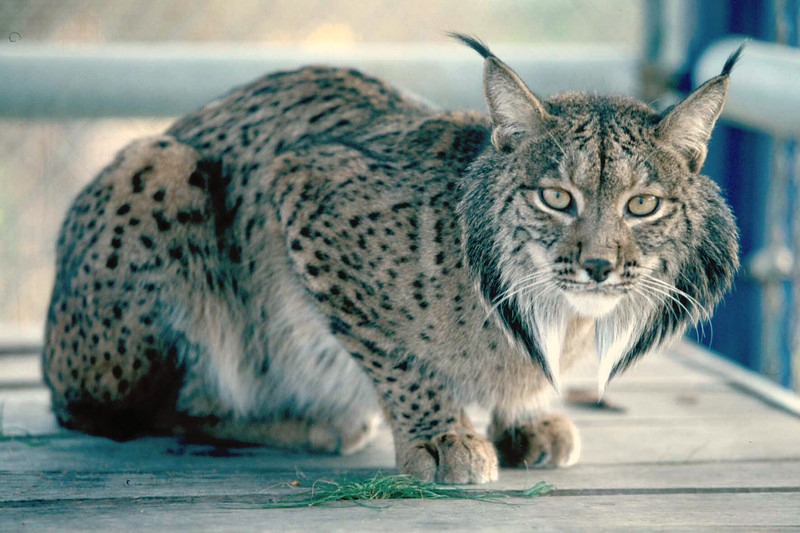
The Endangered Iberian lynx

Who couldn't love this face??
Iberian lynx (Lynx pardinus)
Familiar eyes
Face as regal as it is wild
Remind us there is more to know 
And behold on earth
Than that which we control
Wildcat!
May you roam free once more


What on earth is an Iberian lynx?

The Iberian lynx is a critically endangered species of feline. In fact, the Iberian lynx is the world’s most endangered feline. Intense conservation efforts are currently underway in an attempt to save this beautiful wildcat from extinction.


Why is the Iberian lynx in danger?

  • Habitat loss. The Iberian lynx is specialized and adapted to its habitat. Historically the Iberian lynx lived in throughout the countries of Spain and Portugal. However human encroachment into its habitat today has severely restricted its territory to a few limited areas in southern Spain. See this dramatic depiction of the reduction in the Iberian lynx's range map here.
  • Hunting. Considered as a prize trophy by hunters and as a nuisance by landowners, hunting of the Iberian lynx has also reduced its numbers. Thankfully it is no longer legal to hunt these cats.
  • Disruptions in its food chain. The majority of the Iberian lynx’s diet consists of rabbits. In the 20th century, the European rabbit population was decimated by two epidemics. First was a disease called myxomatosis, which was introduced by humans. Second came a disease called VHD (viral hemorrhagic disease). Unlike other affected predators in the region, the Iberian lynx still relies on rabbits for approximately 75% of its food!

Habitat loss + Hunting + Few rabbits = Almost no Iberian lynx!


What’s so special about the Iberian lynx anyway?

This cat matters! If the Iberian lynx goes extinct, it will literally be the first time in all of history that a feline species went extinct as a result of human beings. That is one distinction we humans should not be proud of!


Will the Iberian Lynx really go extinct?

Good question! A decade ago there were thought to be 200 Iberian lynx in the wild.This put the Iberian lynx into what’s called a “pre-extinction phase”. Without intervention, the world might lose the Iberian lynx forever. That's why conservationists are working so hard to protect this lynx through captive breeding and reintroduction programs.

New hope: all is not lost for this lynx 

Good news! For the first time, scientists have collected and preserved embryos from the Iberian lynx. Scientists hope they will be able to implant fertilized eggs into a surrogate (such as another species of lynx). A successful pregnancy could help boost Iberian lynx numbers. See March 2013 Live Science article here  


RESOURCES!


Video: Earthrise - Saving the Iberian Lynx
Check out this short from Al Jazeera English’s program "Earthrise" to see how scientists are working hard to reintroduce the Iberian Lynx into the wild.


Video: National Geographic - Spain's Last Lynx 

Delve intimately into the world of the Iberian Lynx in this beautiful documentary! Learn about its habitat, life, and the other creatures it must compete with in the wild to stay alive.


Links:
Iberian Lynx page on the IUCN Red List of Threatened Species

World Wildlife Fund page on the Iberian Lynx
 
Iberian lynx article on Scientific American blog "Extinction Countdown"
"Deadly Rabbit Disease May Have Doomed Iberian Lynx"

April 2013 El Mundo article in Spanish on the recent rise in Iberian lynx numbers in Andalucia, Spain.


Iberian lynx page on Wikipedia